

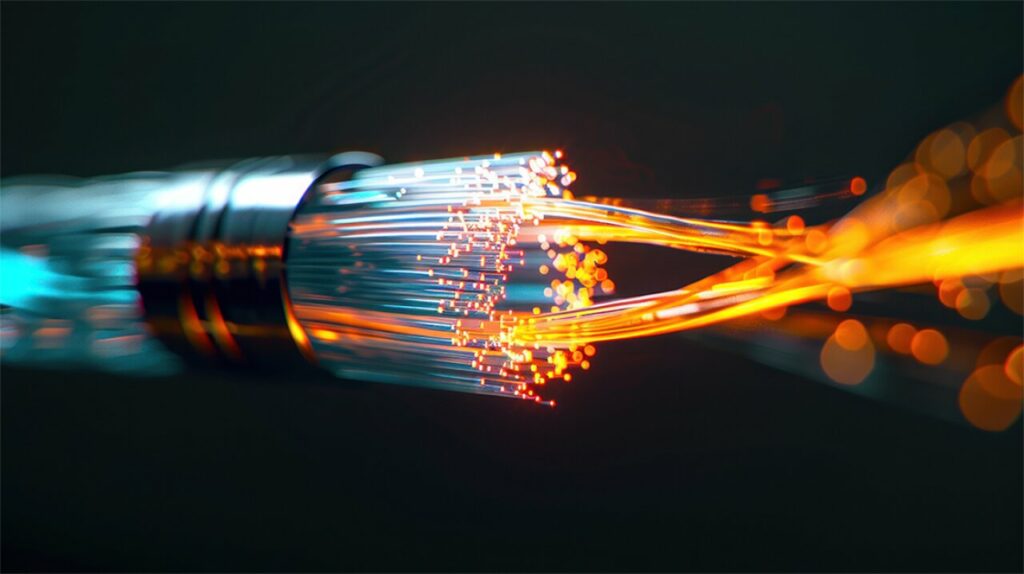
Fiber Optic Installation for East Coast Buildings and Campuses
This page covers the fiber build itself: choosing the fiber, choosing a cable that will survive the route it has to take, installing it without damaging it, and landing it in hardware a technician can still work in years from now. The jobs next to it have their own pages and are not repeated here. The craft of joining fibers together is on fusion splicing and fiber termination. Routes that leave the building — duct, direct burial, aerial, handholes, building entry — are on campus and outside-plant fiber. Proving the finished link and producing the test package is on OTDR and fiber certification.
Choose the fiber for the application it will carry last
Single-mode and multimode are not substitutes for each other, and the choice is made at the optics, not at the cable. Multimode keeps transceiver cost down over shorter reaches, but the distance it supports falls as the lane rate climbs. An OM4 backbone that carries 10G comfortably today may not carry a later parallel-optic application over the same length. Single-mode has no practical distance ceiling inside a building or across a campus, so the constraint moves to the optics chosen at each end.
The useful question is what will light the link in its second and third generation, not what will light it on turnover day. Where a building is expected to outlive two or three refresh cycles, that argument usually lands on OS2 for the backbone, with multimode kept for short equipment-room and horizontal runs where the installed optics already exist.
Strand count and dark spares
Strands added during the original pull are inexpensive. A second cable pulled through a full pathway two years later is not. Count the active links, then add for parallel optics — those applications consume eight or twelve fibers per link instead of two — then add growth, then add dark spares that let a damaged strand be abandoned rather than repaired under pressure. Spare capacity in the pathway matters as much as spare strands in the cable.
Cable construction has to match the space it runs through
Flame rating comes first and is not negotiable: plenum-rated cable in air-handling spaces, riser-rated in vertical shafts between floors, general-purpose elsewhere. Beyond that, tight-buffered distribution cable terminates directly and suits equipment rooms and risers, while loose-tube construction gives the fibers room to move and is the normal choice where the cable will see temperature swing or moisture. Armored cable buys mechanical protection but adds a metallic element that has to be bonded, so it is a decision with a grounding consequence, not just a jacket choice.
Pathway, pulling, and support
Most fiber damage is done during installation, and most of it is invisible until someone runs a test. Pull on the strength members with a proper grip, swivel, and breakaway limit — never on the jacket. Respect the manufacturer’s bend radius, which is larger under pulling load than it is at rest. Long or multi-bend routes get intermediate assists and figure-eight layouts rather than more tension. Innerduct or a dedicated tray keeps a future copper pull off the fiber already there, and slack at both ends pays for itself the first time a panel moves.
In older high-rise stock in New York City and Boston, the riser is the real constraint. Shared shafts, limited sleeve capacity, escorted access, and freight-elevator windows mean the pull plan is built around the building’s rules and after-hours schedule before it is built around the floor plan.
Panels, cassettes, and polarity
Termination hardware is where the build either stays maintainable or does not. Duplex LC remains the workhorse for two-fiber links; MPO trunks with cassettes make sense where port density and future parallel optics justify them. Polarity method A, B, or C has to be settled as a system decision before any parts are ordered, because mixing methods across trunks, cassettes, and array cords produces links that are physically complete and optically wrong. Leave rack units for growth, control patch cord bend radius at the panel face, and label to the same identifiers that will appear in the test records.
Start a fiber build
TekRoute installs fiber across the Carolinas, Georgia, Florida, Virginia, Maryland, New York, New Jersey, Massachusetts, Tennessee, Kentucky, and West Virginia, working from 6201 Fairview Rd, 2nd Floor, Charlotte, NC 28210. Send drawings or a strand count, or describe what has to connect to what, and call (888) 360-0035.