

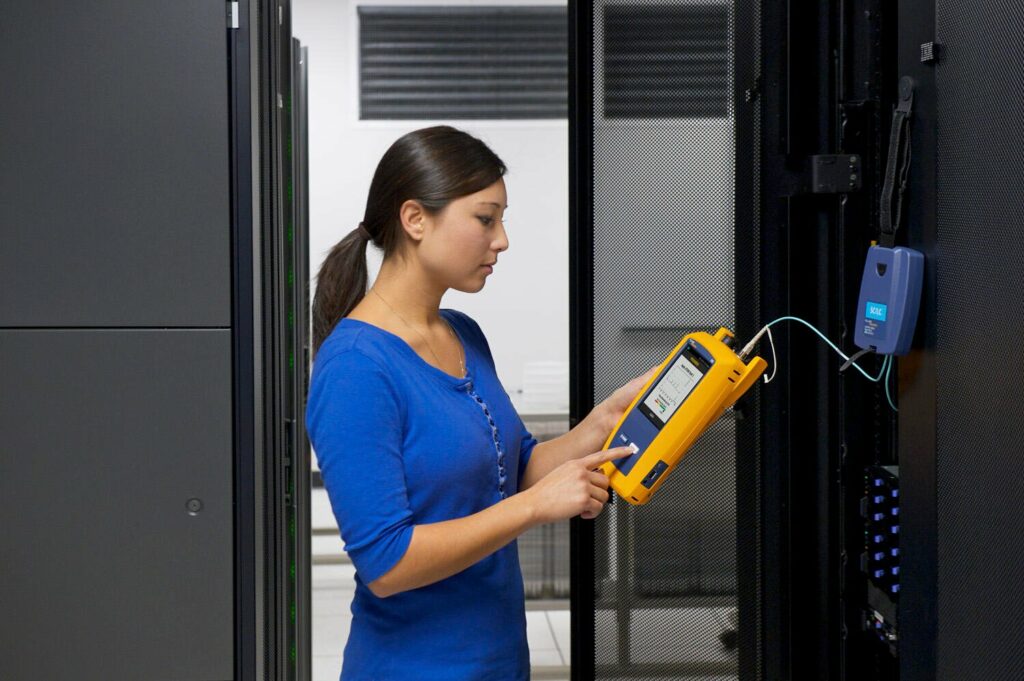
Network Testing and Documentation
A test result is a claim. A closeout package is the evidence behind the claim. This page covers both: the acceptance regime that decides what gets measured and against which limit, and the record that has to survive after the technicians have gone.
This is the page for cabling somebody else installed
The other services in this group describe building new plant. Testing and documentation is the one that also applies to cable that is already in the ceiling. Buildings change hands, contractors close, drawings go missing, and a network manager inherits a few thousand ports with no reliable idea which of them work or where they land. Auditing and documenting an existing plant is a different job from certifying a fresh install, and TekRoute does both. Where the work is new, the installation itself sits on structured cabling installation and Ethernet and data cabling. This page starts once cable is in place.
Settle the limit before the first production test
Everything in a report depends on decisions made before anyone connects a tester:
- Link model. A permanent link excludes the patch cords and is what an installing contractor is normally held to. A channel includes them and reflects what the user experiences. The two give different numbers on the same cable, and a specification that does not say which one it means is an argument waiting to happen at handover.
- Limit and standard. The category and the standard revision the results are judged against, named explicitly in the specification rather than left to the tester’s default.
- Fiber tier. Tier 1 insertion loss, measured with a light source and power meter, establishes whether a link falls inside its loss budget. Tier 2 adds an OTDR trace showing where the events along the span are. Tier 1 is the acceptance measurement; Tier 2 characterizes the plant and finds the fault.
- Adapters, cords and references. The correct permanent link adapters, current firmware, and a reference set at the start of each session and again after any change to the reference cords.
What a copper report has to show
Wiremap, length, insertion loss, near-end crosstalk and its power-sum form, return loss, propagation delay and delay skew, measured per link against a named limit with a pass or fail on each. Where the plant carries Power over Ethernet, DC resistance unbalance belongs in the set as well, because a link can pass the conventional data parameters and still deliver power badly.
Failures belong in the record
Failure handling is where test packages usually fall apart. A failed result quietly deleted and re-run after a repair leaves no trace of what was wrong or what was done about it. TekRoute preserves the original result, records the diagnosis and the repair, and files the retest against the same identifier, so the package shows a history rather than a spotless sheet that invites suspicion. On a large plant, the deficiency log is often more useful to the owner than the passing results are.
Native files, not screenshots
A PDF summary is readable, and it is not sufficient on its own. The tester’s native files are what allow a future contractor to open a result, compare it against a fresh measurement, and re-evaluate it against a different limit. Both belong in the package, and so do these:
- A naming scheme where the ID on the jack, the ID on the panel, the ID in the test file and the ID on the drawing are the same string
- Port schedules reconciled against the as-built condition rather than against the design drawings
- Rack elevations and room photographs showing the plant as it was actually left
When you test changes what you measure
Copper results move with temperature. A plant tested in an unconditioned building during a Carolina or Georgia summer will not read the same as the same plant tested once mechanical systems are running, and links close to their limit are the ones that move across it. Where a construction schedule forces testing before conditioning, the ambient conditions belong in the record so that a later retest can be compared honestly.
Request a testing scope
Tell us the port count, the media involved, and whether you need acceptance testing on new work or an audit of a plant nobody has records for. The number is (888) 360-0035, and the office is at 6201 Fairview Rd, 2nd Floor, Charlotte, NC 28210.