

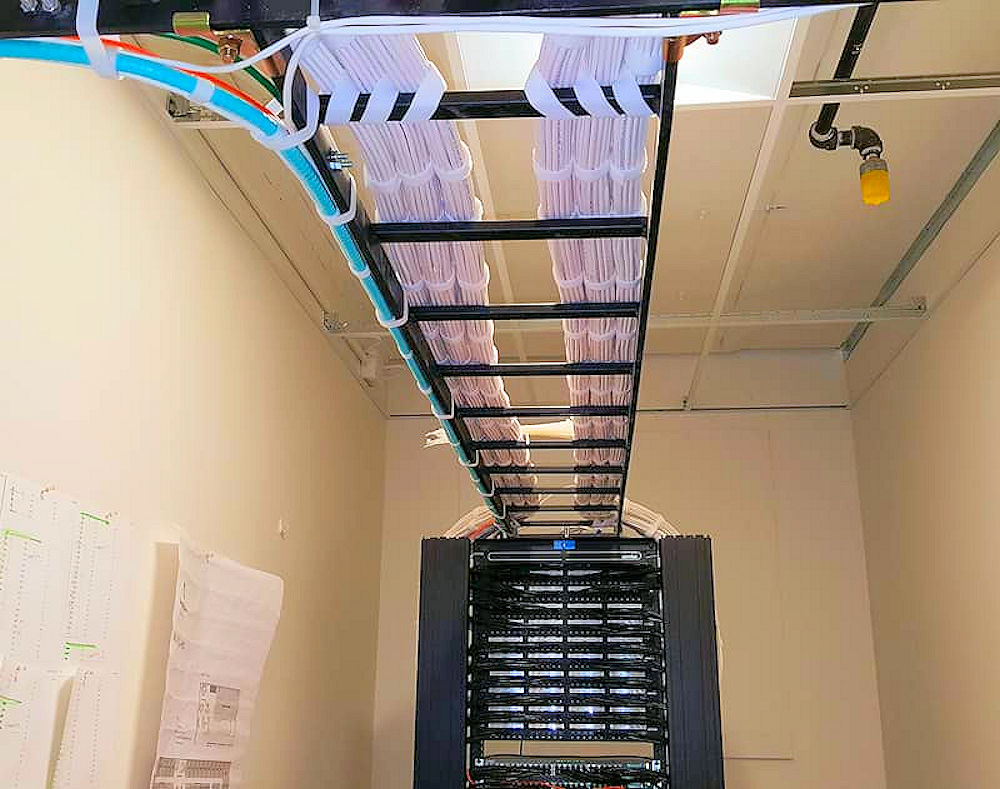
Ethernet and Data Cabling
One run, from a port on a patch panel to the thing on the other end. That is the subject of this page: the individual horizontal cable that leaves the telecommunications room, crosses a ceiling, and terminates at a jack, a camera, an access point or a door controller. Each of those runs carries four decisions, and the cost of getting them wrong stays invisible until the plant is loaded.
The rooms, risers and pathways this cable travels through are a separate scope, described on structured cabling installation. The limits the finished run is later held to are on network testing and documentation. Here the subject is the media and the endpoint.
Which category does this run actually need?
Category 6A carries 10GBASE-T for the full horizontal distance. Category 6 carries it only over shortened lengths, and how short depends on how much alien crosstalk the surrounding bundle produces, which is why Cat 6 is a defensible choice for a run expected to stay at 1 Gbps and a poor one for a run that might be asked for ten times that in a few years. Category 5e is still in service everywhere and still passes for gigabit, but it is not what you install new.
The useful version of this question is not what speed you need today. It is how long the cable will be in the ceiling and what will be plugged into it by then, because replacing horizontal cable means opening ceilings again and paying for that access twice.
How hot is the bundle going to get?
Power over Ethernet has climbed from roughly 15 watts at the source under the original standard to around 90 watts under IEEE 802.3bt Type 4. That power becomes heat inside the cable, and a cable buried in the middle of a large bundle has nowhere to shed it. The standards deal with this through a length de-rating tied to the ambient temperature the bundle sits in, so the maximum usable length shrinks as the space gets warmer.
This lands harder here than in cooler regions. A ceiling space above a conditioned office in Charlotte, Atlanta or Tampa in August is not sitting at the 20 degree Celsius reference the de-rating is written around, and a warehouse ceiling on the Georgia coast is a long way from it. A bundle of PoE-loaded cameras pulled to nominal length is not the same cable once it is in that space. TekRoute sizes bundles, picks conductor gauge and plans routing against the temperature the ceiling actually reaches. Larger-gauge conductors are the straightforward lever, since lower DC resistance means less heat for the same delivered power.
Where does the cable end?
Most runs end at a jack in an outlet or a patch panel, which is the arrangement the permanent link test model was written around. Some end in a plug terminated directly onto the horizontal cable and pushed into the device, a modular plug terminated link, which suits a ceiling-mounted camera or access point where an outlet serves no purpose. MPTL is a recognized configuration, but it is tested as its own model and removes the ability to swap a cord when something fails, so it belongs in the design rather than in field improvisation. A consolidation point is the third option, appropriate in open office areas where furniture layouts change more often than the cabling behind them.
- Shielded or unshielded, decided by the noise environment and by whether the site can genuinely maintain a bonded shield path end to end
- Jacket rating matched to the space, with plenum-rated cable where the run passes through an air-handling ceiling
- Solid conductor for the horizontal run, stranded for the cords at either end
Do the parts add up to one channel?
A category rating belongs to a channel, not to a box of cable. Cat 6A cable terminated on Cat 6 jacks and patched with unrated cords is a Cat 6 channel at best and frequently worse. TekRoute keeps cable, jacks, panels and cords inside one performance design and records which parts were used, so an add two years from now does not quietly degrade a link that passed cleanly on day one.
Discuss a cabling scope
Bring the device count, what will be powered over the cable, and an honest answer on how warm the ceiling gets. Call (888) 360-0035, or reach the Charlotte office at 6201 Fairview Rd, 2nd Floor, Charlotte, NC 28210.