

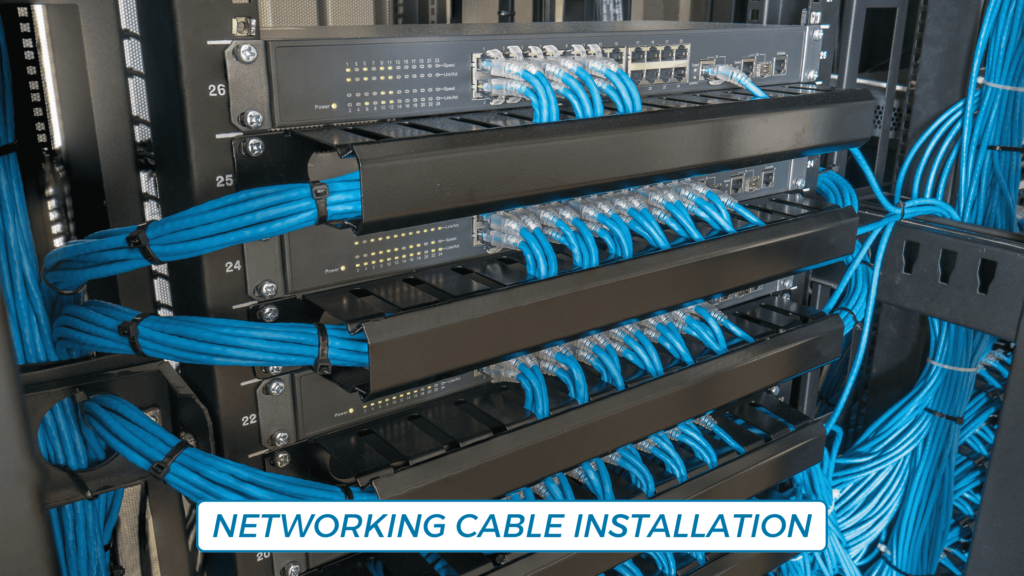
Structured Cabling Installation
Structured cabling is the layer of a building’s network that outlives the equipment plugged into it. Switches and access points get replaced on a few-year cycle. The telecommunications rooms, risers, conduit and cable tray stay where they were first put, and every later move, add and change is constrained by those original decisions. TekRoute installs that layer across the East Coast, from the Carolinas through Georgia and Florida and north into Virginia, Maryland, New Jersey, New York and Massachusetts.
The boundary of this page
This page is about the cabling system: how many telecommunications rooms a building needs and where they belong, what the backbone between them is made of, how pathways are sized and supported, and how the whole plant is bonded and named. It is not about the individual run to one desk, camera or access point, because category, jacket and PoE decisions for a single horizontal cable are covered on Ethernet and data cabling. It is not about proving the finished plant meets its limits, which is the subject of network testing and documentation. And if the cabling begins at a carrier’s handoff rather than inside your own plant, that is demarc extension work.
Room placement sets everything downstream
Balanced twisted-pair horizontal cabling is limited to a 90-meter permanent link, and 100 meters once the patch cords at each end are counted. That single number decides how many telecommunications rooms a floor needs and where they can sit. A room positioned to suit the architecture rather than the cable reach leaves part of the building unservable without adding a room later, usually into space that has already been assigned to something else. TekRoute works the room plan against routed distances rather than straight lines on a drawing, because the path over the corridor, around the duct and down the wall is what actually gets measured.
Room readiness is the second question. A telecommunications room needs conditioned air, dedicated power, a clear service area in front of the racks, and enough wall and rack space for the panels the design calls for plus room to grow. In warehouse and distribution buildings through coastal Carolina, Georgia and Florida, network rooms are often carved out of unconditioned space, and the humidity that comes with that shortens the life of connecting hardware. Whether the room gets conditioned is a decision to settle before cabling lands in it, not after.
Backbone and pathways
Backbone cabling ties the entrance facility, the equipment room and the telecommunications rooms together. Choosing between copper and fiber backbone, and between multimode and single-mode where fiber is used, follows the distance, the aggregation speed you expect to be running in five years, and how much spare strand count is worth paying for now against pulling again later. Pathways follow the same logic: tray and conduit sized for the fill they will hold after two rounds of adds, with bend radius maintained at every transition.
- Sleeve and slot capacity through rated floors and walls, with each penetration restored using a listed firestop system
- Support spacing that carries the bundle without deforming the cable jacket or crushing the pairs beneath
- Separation from power conductors, ballasts and motors held along the full route, not just at the ends
- Spare pathway capacity reserved and written down, so the next contractor is not guessing
Bonding and administration
Racks, panels, cable shields and enclosures are bonded back to the telecommunications grounding system rather than treated as incidental metal, and that bonding path is worth confirming rather than assuming. Alongside it, every cable, port, rack and room gets an identifier under one scheme applied consistently across the site, so the label on the jack, the label on the panel and the entry in the record all agree. A plant that is installed well and named badly still costs money on every service call for as long as it is in the ceiling.
Start the conversation
Send floor plans, the room list, and what you expect the building to hold in five years rather than what it holds today. TekRoute works from 6201 Fairview Rd, 2nd Floor, Charlotte, NC 28210, and the number is (888) 360-0035.
Structured cabling cost, testing and contractor scope
Use this parent-company infrastructure guide to compare pathway, testing, documentation and lifecycle requirements alongside TekRoute network delivery.
Discuss installation, maintenance or service
Detailed guide maintained by 360TechnologyGroup.com, the parent-company knowledge center.